Showing posts with label Newt Gingrich. Show all posts

October 29, 2007

Gingrich Speech


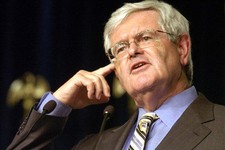
I sat on the floor near the exit, off to the side near where the press sat at the FRC Action Values Voter Summit: The Washington Briefing. It was in a huge ballroom in the Washington Hilton in DuPont, which I found highly ironic. I had raced there, trying to make it in time to hear Newt’s speech. While getting set up to take notes, I was trying to change into red heels—appropriate, I figured, for one of the biggest conservative conventions of the year. Newt was the last speaker of the daytime session.
Enthusiasm rose as Newt was introduced as the former Speaker of the House, author of Rediscovering God in America, the Chairman of the Gingrich Group The Gingrich Group, and “a drum major in our march for a better future,” among his other accomplishments. Rock music played as he walked on stage and he was met with a standing ovation and thunderous applause. Ladies and Gentlemen, Newt Gingrich.
You know how in the press club speech we watched, Newt was very good at appealing to both sides, while still maintaining his conservative viewpoints? That was perfect for the National Press club. This speech was also very much tailored to the audience. He showed a lot statistics, most of which are available here. According to his statistics, 86% of all Americans believe there are certain values that unite us all. The statistics he cited mostly involved national defense, taxes, religion, and morality. For example, 85% of Americans believe it is very important to defend American allies. 89% believe religion and morality are important to their family. 64% believe that there is not enough religion taught in school. Only 8% believe that there is too much religion in school, “which” he said, “must be the size of the ACLU.”
Gingrich said that the “elite critics” misunderstand what the argument regarding religion in schools and in the nation is really about. He said he is not advocating theology to be taught in school, just political history. When Thomas Jefferson wrote The Declaration of Independence he did say that we are “endowed by the Creator with certain unalienable rights,” even if he was a deist. Newt also looked at Washington, who was a Christian and Benjamin Franklin, another deist, who called for a day of prayer during the Constitution Convention. Gingrich notes that Lincoln spoke of God fourteen times in the 2nd Inaugural Address, as is written in the Lincoln Memorial. FDR, during his radio talks to the nation asked his listeners to join him in prayer for D-Day.
He did not deny the need for separation of church and state. However, he clarified what he meant by that separation. He said that when Jefferson used the term, he was writing a letter to reassure someone that there would be no compulsory, state-funded religion above the other religions. “Good,” was Newt’s description of the separation of church and state. He doesn’t want the Government funding religion when it, “can’t even fund the Federal Government.”
Newt emphasized that The Constitution says “We the People,” not “We the Lawyers,” and not “We the Politicians.” He said that we lend the politicians our power, it is not theirs to legislate without control. We have the right to fire the politicians that are mishandling power every election.
From a purely political standpoint, Gingrich said very little. Other than mentioning that Immigration should be encouraged (but that the Immigrants need to become Americans and learn English), Newt mostly discussed American history from a Christian perspective.
On the way out of the conference, Newt had people handing out handouts to read the way a teacher does in a class.
To show how well his speech went over at the conference, after his speech—when Newt was signing autographs in his books and taking pictures with his fans, his book sold out completely.

October 19, 2007

Conservatism, Debate Reform, and FedEx

Guest speaker Rick Tyler spoke with Dr. Dana Walker’s Dissident Media class at American University on Oct. 19, 2007.

Some background info…

Rick Tyler currently serves as the press spokesman for former Speaker of the House, Newt Gingrich.

He is a conservative political strategist, and senior partner at Chesapeake Associates, a professional campaign consulting firm.

Tyler was the Executive Director for the Maine Republican Party for five years before moving to the nation’s capitol, where he is now the Director of Media Relations for Gingrich Communications, according to his website.


Let the live blogging begin.


“It’s not often that a member of Newt Gingrich’s staff gets willingly invited to talk to a college class,” Tyler said, greeting a class of almost 30 laptop-armed students.

He took no time getting started. Asking the class how we decide who to vote for, he received various answers from the class. “We go online,” someone said. “Television,” said another. Tyler explained in his day there were only four major networks, compared to today’s common choice of 500 available satellite channels.

Tyler said there is probably less than 10% of the entire American population paying attention to the presidential election. Keep in mind this blog is coming from a university where nearly every student has a political opinion.

Obviously this statistic doesn’t apply to anyone in the room, Tyler said.

He compared the percentage of his life that’s dedicated to politics compared to that of “normal people.” Ninety percent of his life, he claimed, was encompassed by all things political.

“You’re weird!” Tyler said to the students who claimed they watched Sunday morning talk shows, rather than sleep, watch football, or play golf like “normal people.” He was trying to reiterate that most of the nation doesn’t care most of the time about politicians or political issues.

On the topic of television, Tyler recalled the first-ever televised presidential debate – Nixon v. Kennedy. This debate took place where they now do the Meet the Press with Tim Russert, he said.

“What do you think is wrong with today’s current political debate?” Tyler asked the class.

“It’s too rigid and lifeless…They just give the answers they know the voters want to hear,” replied a student.

“You think people can see through that?” Tyler asked, “I do too.”

Tyler criticized the current debate structure, describing it as unproductive and “ridiculous.”

“What’s your answer on Iraq? Thirty seconds.” The buzzer rings faster than you can say “Uh… well…where do I begin?”

What’s his solution to the rehearsed, rapid-fire, sound byte-laden debates today?

He mentioned that his boss, Newt Gingrich, proposed that two candidates get on stage and talk it out in an anything-goes style forum. If they’re from opposing political parties—great. He also briefly mentioned Newt’s NNN plan, which is discussed further down in this post.

“I’d love to see bipartisan debates. If you put a bunch of republican/democratic candidates in a room full of republican/democratic voters they sound like CrAzY right-/left-wing fanatics!!” he said.

On the subject of registered independent voters, Tyler claimed they “have no voice.” He said they have to wait for the “crazy people” to make up their minds between candidates, before an independent voter can have his or her own choice.

As a registered independent, I don’t react well to this statement. Tyler spoke in front of a class that is structured to force students to have their own voice. The term “dissident,” as in Dissident Media, in itself reflects a minority that do not associate with the mainstream press.

To say someone doesn’t have a voice because they don’t associate with one of the two major parties? I don’t know about that. I understood what he meant, that we need to restructure the debate system to give undecided voters a better opportunity to decide between candidates, but he could’ve worded that more eloquently.

Tyler also spoke of newsworthiness. “Does anyone remember what the media was covering on September 11, 2001?” After a few hints, no one in the audience could recall that this was the summer Chandra Levy went missing. That was to be expected (it was over six years ago).

Newsworthiness is highly influenced by a struggle for ratings, Tyler said, “Why be afraid of freedom? I’d like to see no limits.”

If you’re a candidate, you have the weakest position to define your campaign, Tyler stated.

Tyler then advocated for transparency in government. Right now, campaigns are financed by "bundlers," organizations with names like “Voters for a Better America.” Does anyone actually know where this money is coming from with a name like that?

“I love the five dollar voter.” Big donators are just buying influence, which they get through access.

Tyler asked a number of questions about our lives in a technological age, including ones on floppy disks, records, and rotary phones. Doing so provided a comparison between today's world and the one of only a couple decades ago. Not that this topic needed addressing to a class where nearly every student had a laptop, complete with wireless Internet access, in front of him or her.

This was taken almost directly from Newt Gingrich’s speech at the National Press Club, which is available at the AU library for any AU students reading this. Tyler exemplified the ridiculousness of the fact that FedEx can track about 20 million packages a day, to six-sigma accuracy. Whereas the Federal government can’t track 11 million illegal aliens? Newt Gingrich’s suggested solution: send each illegal alien a package through FedEx or UPS. If that doesn’t get you laughing, check your pulse.

Gingrich calls his debate reform proposal the “Nine Nineties at Nine” plan. Namely, nine candidates speak for ninety minutes every Sunday for nine weeks before the election.

According to Tyler, this plan would allow the candidates to talk about a range of issues for longer periods of time. The debate topics would be chosen by the candidates themselves. This brings us to the question of how do the candidates choose which topics they should discuss?

“Dan Rather essentially got fired by a blogger! Think about that,” Tyler said.

Tyler maintained that the chance a citizen has today of bringing an issue to the attention of the Speaker of the House is much greater, mostly through online blogging, than it was when Gingrich was Speaker. Now, by means of the Internet, voters have more control over which issues get the most attention.

Then the floor opened to questions, of which I include only one.

“What has caused this degenerative debate structure?” one student asked.

Tyler’s answers were money, the financing of campaigns, and the competitive nature of the news media, which has focused people on trivia.

“I think the media has done a terrible job at articulating what people actually get,” Tyler claimed after he explained that every voter only wants to know what he or she will get by electing a candidate.


October 1, 2007

There are some things money can't buy; for everything else, there's American ignorance!

Oh, Newt. While I'd like to think you took my advice last week and realized that raising $30 million in 3 weeks was impractical, I'm sure that was not the case. I won't argue the importance of your political action committee, American Solutions, or the difficulty of obtaining funds this late in the race...

...ut I can use your reluctance as an example of what I think is most disturbing about American politics.

Take, for instance, CNN's most prized headline this chilly evening, which (perhaps discretely) applauds Sen. Barack Obama's $20 million (and possibly more) fundraising blitz this quarter. The not-so-shocking amount puts the not-so-inexperienced senator at about $74.9 million this election cycle.

For anyone interested in the math, that amount would cover nearly 44,600 AU students' financial tabs... yea, tell me about it...

Anyway, the amount, in my mind, really forces us to reconsider the age old question: to whom are the candidates most accountable or responsible? Sure, we'd like to believe in the merits of basic democratic theory, that our electoral system only allows the most qualified and (or) popular candidates to assume office. But what about the thousands of interest groups, PACs (like Gingrich's) and businesses who donate the most money to presidential candidates? It's true; the larger one's coffers, the better one's chances at securing success in the primaries.

I mean, this isn't always the case; Howard Dean and John McCain, in their earlier runs for their respective party's nomination, far outdid their competition. But for the most part, donations produce votes. Fundraised dollars means advertisements and canvassings, appearances and stump speeches, bigger staffs and more ambitious goals; more showiness, more political grandeur, more pageantry, all of which is uncharacteristic of real grass roots democracy.

And when the media hypes earnings, they give the impression that the candidate with the most money is indeed the most popular. Granted, this is sometimes true (or near true), as a recent CBS poll of the Democratic field would demonstrate. But any publicity is good publicity. Why would an able minded middle or low income American donate a large sum of money to a candidate (who perceivably promised adequate representation of their demographic) the media depicts as losing or already lost? It's paradoxical, to say the least.

So when I hear the big guys like Gingrich and Obama lambasting the political system while fretting over much-needed campaign dollars, I start to wonder whether this whole "we're going to change American politics as we know it!" scheme is nothing more than an excellent sound byte. You can't change America's election structure if the most contact you have with the country is the random debate and the occasional thousand-per-head dinner. It's about time someone realized that...

September 28, 2007

If only I could raise $30 million in three weeks...

According to CNN's Political Ticker, Newt Gingrich announced Monday that he would enter the campaign if donors contributed "at least $30 million... over a three-week period starting Monday and ending Oct. 21."

But before you all experience a euphoria-induced blog-o-seizure, let's think about Gingrich's chances should he enter the 'invisible primary.'

As most of you have probably noticed, a couple battleground political states are waging a rather subtle yet important war. Each vying to overtake New Hampshire for the title of 'first primary,' preliminary elections are moving closer and closer to the beginning of 2008. I've even heard CNN refer to what was known as 'Super Tuesday' as 'Super Duper Tuesday' (thanks, Wolf...) because the primaries now resemble a sort of national referendum on the candidates.

That effectively leaves Gingrich four months to campaign; a hurdle that underlies the effects of unequal media (in)exposure during the primary process.

And let's not forget Gingrich's $30 million challenge. As of June 30, 2007, the top two candidate in terms of fund raising, Mitt Romney and Rudy Giuliani, campaigned for nearly $35 million and $33 million, respectively.

In other words, Gingrich hopes to do in three months what the current candidates have been doing for well over six. That's a little too idealist for me.

I mean, I, like anyone else, want to see a competent man or woman elected to the office of the president in 2008. I, again like the rest of this Web site's bloggers, hope the person who makes the grade does so fairly and openly with as much discourse as possible. But there is a fine line between idealism and pragmatism. Gingrich should run, but he needs to tone down his expectations if he wants to be successful; expectations are usually the reasons candidates fail. And he has to remember that despite his criticism, the system is what it is. He can hate the present state of political discourse and lambaste the insular primary or donor systems all to the approval of voter applause, but he has to play and rely on the system if he wishes to fix it. Tis the irony of politics.

The political clock is ticking, Newt.

September 27, 2007

Gingrich in the Race?

After our discussion last class of Newt Gingrich and the possibility of him running for President in the 2008 Election, I was interested to learn more. Surprisingly, I found a website already in tact dedicated to drafting Gingrich as a political candidate for the 2008 Election. The website DraftNewt.org is a comprehensive website with lots of information on why Gingrich should run for President, how to raise awareness, become involved, etc. The headline at the top of the home page reads: "Draft Newt '08; The 21st Century Demands a New Contract with America"and latest article on the page is entitled "Newt Gingrich: The only individual worthy of the GOP and America". They've also included the script from Gingrich's appearance on FOX News Sunday and his discussion of what it would take to get him to run in the 2008 Election. E Even more interesting is that they include a way to contribute to the "campaign". Their fundraising campaign is Twelve dollars. Two weeks and 2 million people campaign. Where exactly is the money going? They are "Not affiliated or authorized by any candidate, party or party committee," it states at the bottom of the website. They do not list when it was created either, so I've emailed the creators in an attempt to learn more about it and find out if there has been any response from Newt Gingrich, himself, about the website and campaign draft. Hopefully there will be more to come on this topic.